Whitepaper

Over 130 questions from the community. The most important answers.
Who is this whitepaper for? For communications professionals who don't need more AI hype – but rather clear answers to the questions they’ve been asking themselves for a long time.
Enjoy the read.
AI is the topic of the moment: a transformation that is reshaping our world of work and, by extension, half of society; to some degree, it affects everyone. There is a lot going on, including in our niche. Still, we were surprised by how intensely the topic is resonating: over 130 questions were submitted before the webinar "How AI-ready is your comms department really?" with Laura Lewandowski ("AI Queen," former journalist and founder of smart chiefs) and Max Ziche (getpress CEO, TEDx speaker and podcast host), and dozens more were added during the session. In the end, the clock hit 75 minutes because we simply had to run over due to the volume of questions – over 300 people were there (despite the holiday season), many with more than one question in tow.
Yet the internet is full of this topic: tips, frameworks, books, courses, and training at every turn. It feels like every second person is currently claiming AI expertise. But there are also those who have been dealing with it for a long time – people like Laura, who shares tips almost daily. We have also done several episodes on this in our podcast, narrative now, including the conversation with Laura about AI leadership. So why are there still so many unanswered questions? Because the topic challenges everyone while simultaneously creating uncertainty. New releases every week, tips from all sides, and those working in large corporations often aren't even allowed to use half of them. It’s perfectly normal that no one can keep up. And we see that as a good sign: the topic is far from being exhausted; it is just starting to get seriously interesting.
This whitepaper doesn't just repeat what happened in the webinar. We answer questions from the community, clustered by topic and frequency – we are certain that there is something here for everyone, even those who weren't there. A quick reality check: the EU AI Act gets serious on August 2nd. Question 16 clarifies what that means for your texts.
What to expect:
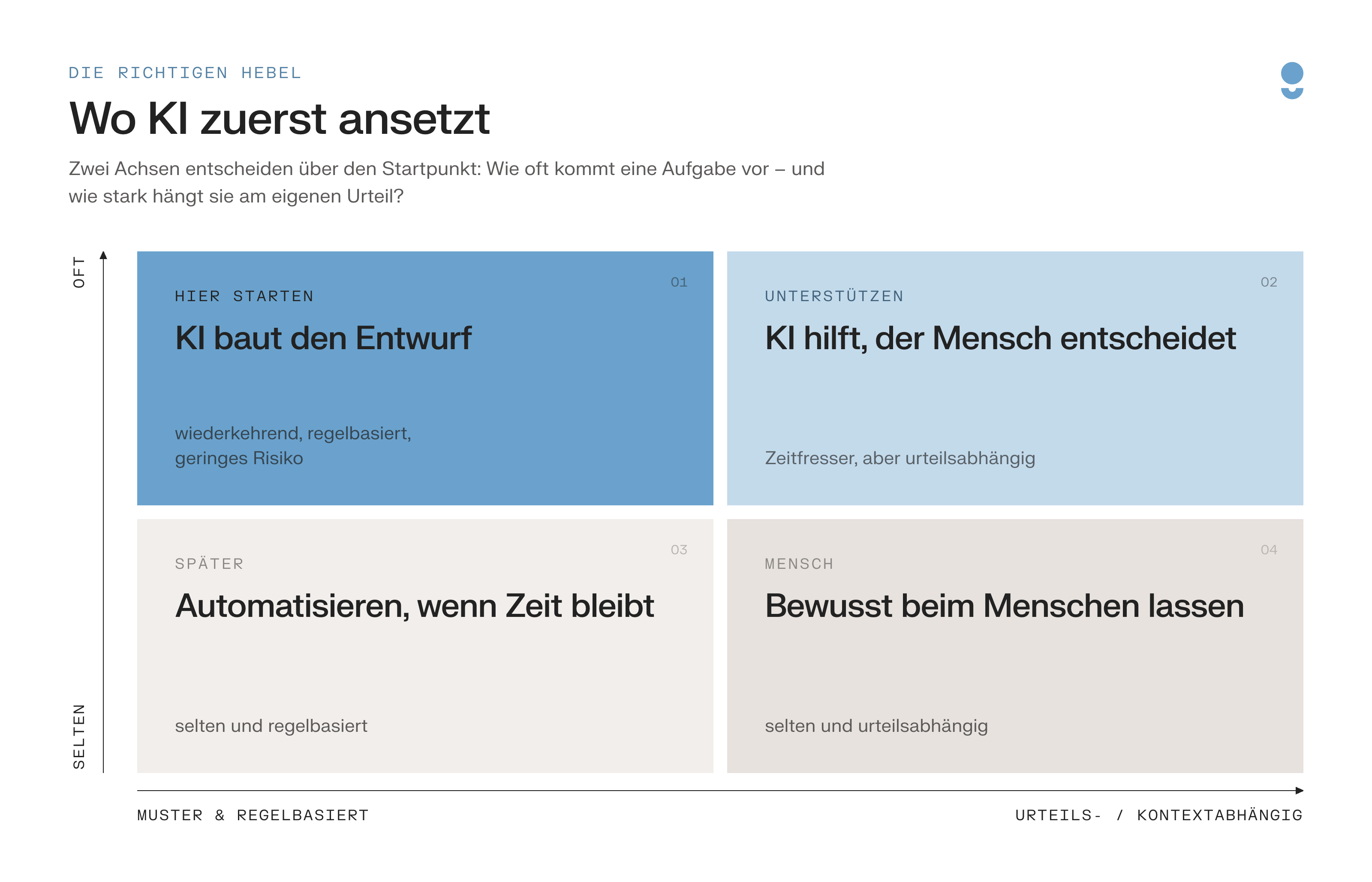
No single question came up as often before the webinar, or in as many variations. The answer is based on a simple two-axis matrix: How often does a task occur? And how complex or judgment-dependent is it? Rule-based, recurring tasks with low risk, such as copy editing or a weekly newsletter, are the ideal starting point. Tasks with high variance or one-off characteristics, such as reporting on an irregular conference, are hardly suitable for automation. It sounds simple, but it helps you find the right place to start.
During the webinar, we conducted a live poll on how participants are currently using AI. By far the most common answer: writing text. Data analysis? Almost non-existent. That is exactly where the untapped potential lies. Analyzing click-through rates and user profiles to identify patterns is often more valuable than another automated text draft, as is pattern recognition in pitch success rates with journalists—an area that hardly anyone is systematically addressing with AI yet.
GEO, AEO, AI Visibility: We all know that your brand needs to appear in ChatGPT, Perplexity, and Gemini. The more interesting question is how. And that came up in several variations before the webinar. The basic logic: language models don't just get their information from your website. Editorial sources, reference pages, and trade media play at least as large a role in how a topic is represented in AI responses. Those who rely solely on their own website are cited significantly less often than those present in independent editorial sources. Furthermore, the weight a model gives to certain sources varies by industry. Different media matter for a fintech company than for a consumer brand, so it is worth looking at which sources are actually cited in your category. For measurement, there are specialized trackers such as Peec AI or Finseo, which can be used to map your own presence compared to the competition.
A quick self-check before you read on:
If at least one answer is a hesitant "not really," it’s worth having a conversation: Linda, Growth Manager & Lead Demand Gen at getpress, invites you to an AI Visibility Audit for exactly these cases. Get in touch with us.
Of course, you are not just concerned with the "how," but also the "who": What do the teams, roles, and skill profiles of the future look like? What do I need to master to not only avoid being left behind but to stay at the forefront? In mid-July, as part of our comms collective , we asked a panel exactly that: nearly 40 comms leaders gathered at the Lighthouse Night in Berlin to listen to Elisabeth L’Orange (Partner for AI & Data at Deloitte, founder of Oxolo), Boris Bolz (formerly Germany head of Red Bull and part of the RTL executive board, now an executive coach), and Elina Schneiders (Head of Comms at Mister Spex). What was discussed there in detail remains confidential. However, we did get permission to share a few quotes so you can get the key insights.
One of them in advance, because it sets the framework for everything else. Elina Schneiders summed up why all the effort is worth it: "Everything I save in time, I invest in strategically important topics that create real added value for the company." That is exactly what every answer in this whitepaper is about: what the time gained is used for, not time-saving as an end in itself.
In short: execution is losing value, while judgment is gaining it. Routines like press distribution lists, standard reporting, and initial drafts are shifting to agents in the background. The curating, decision-making role is becoming more important: who selects what goes out, who is responsible for the tone, who maintains relationships with journalists. That was the core of good communication work even before AI, and it remains so, regardless of which tool handles the rest.
When phrasing and reach are no longer unique, value shifts to where scarcity remains: critical thinking, curation, and trust built over time. In a world full of synthetic media, verified information that a human puts their name behind becomes the truly valuable asset. In its report, Gartner projects “Top Predictions to Inform 2026 Comms Strategies” that PR and earned media budgets will double by 2027, as AI search systems increasingly replace traditional search, disproportionately favoring independent, editorial sources over paid content.
To be honest: You can spot a text that hasn't been edited. It sounds like AI-generated mediocrity, and your readers will notice that faster than you’d like. A text that has been filtered through a unique voice doesn't have that problem, regardless of where the first draft came from. Authenticity means more than just clean editing: it means contributing your own opinions, original ideas, and fresh perspectives instead of just letting the AI reproduce content.
And regarding the concern that readers will be oversaturated and hard to reach in a year or two: that is exactly why you should prioritize quality over quantity. This also applies to how you approach journalists. AI-generated mass outreach without a genuine hook will damage your reputation with newsrooms rather than build it.
Several of you have expressed this exact concern, and it is valid. The warning signs are quite reliable: everything suddenly sounds the same, whether it’s a newsletter, a LinkedIn post, or a press release. No text takes a stand anymore, the same phrases appear everywhere, and let’s be honest: any paragraph could just as easily have come from a competitor. The simplest test is to ask one question of your finished text: Is there anything here that could only come from you—an opinion, a detail, an experience? If not, the AI has taken over too much of the voice. The antidote is in Question 5: edit, inject a point of view, and document your own voice so that it is integrated into every draft—via a skill or style guide—instead of hoping it comes through on its own.
One of the submitted questions specifically asked if tools like Notion are suitable for this. Spoiler: It’s not about the tool. The answer depends on your company, your industry, and your people. At getpress, ongoing, case-based training works best because the pace of development cannot be captured in a single workshop. The principle behind it is more important: as soon as one person on the team develops a successful workflow, it is shared and scaled instead of remaining in one person's head. Whether that happens in Notion, a shared folder, or a skill library is secondary. This bottom-up empowerment is the real engine of learning, not a one-off training session. Here is what that looks like for us in practice:
How far can bottom-up go? We are currently building our own AI-powered operating system at getpress for our PR work, based on the needs of our employees. More on that elsewhere soon.
Following up on a question from the webinar: Is a team using AI only as strong as its weakest link, or as strong as its first mover? Without a shared knowledge base, it tends to be the former, as valuable insights remain siloed with individuals. Once successful skills are systematically shared, however, the first mover pulls the entire team forward.
If you want to dive deeper: Laura discusses why AI leadership requires rituals rather than one-off workshops in our podcast, narrative now: “AI Leadership, Storytelling as a Key Competency & Germany’s Perspective on AI”
At the Lighthouse Night, Boris Bolz summed up the principle behind all the following answers in one sentence: “The outcome is determined before the first prompt, not after.” That’s why this is less about specific tool names and more about the logic behind them.
Laura demonstrated this in the webinar using her own setup for her newsletter. She collects ideas via Telegram, an interface writes them into an Airtable database, and Claude prioritizes content based on the "taste" and target audience it has learned. For research, Perplexity is integrated directly into the workflow as a connector, ensuring that citations are preserved and no one has to jump between the chat and the browser. The takeaway: taste is built through a data foundation that grows over time, not through a single good prompt.
Certainly not by asking the AI, “Give me ten topic ideas.” That just produces generic content—naturally, the model is trained primarily on average data. In the webinar, Laura showed a better approach: the spark comes from a human, Claude acts as a coordinator and analyst, and a web research agent combined with insights from your own usage provides the substance. Two things make the difference here. First, pre-filtered sources: instead of scanning the entire internet, your agents focus on curated feeds and alerts. This separates signal from noise and saves costs along the way. Second, your own data: what have your readers clicked on, opened, or shared recently? One of Laura’s newsletter topics was born exactly this way—from a single figure in her engagement data.
Laura answered this in the webinar as well; the short version is: don't do it within the agent itself. An individual chat doesn't remember anything beyond its own session. Real learning happens in the documentation surrounding it, where feedback is incorporated into a skill or knowledge base that the next iteration automatically accesses.
More than most people think. But not everything—that’s the point. Max has built a fairly elaborate Claude process to support his personal branding on LinkedIn. Two autopilots collect knowledge and hooks in the background, while he retains control over the perspective and final approval:
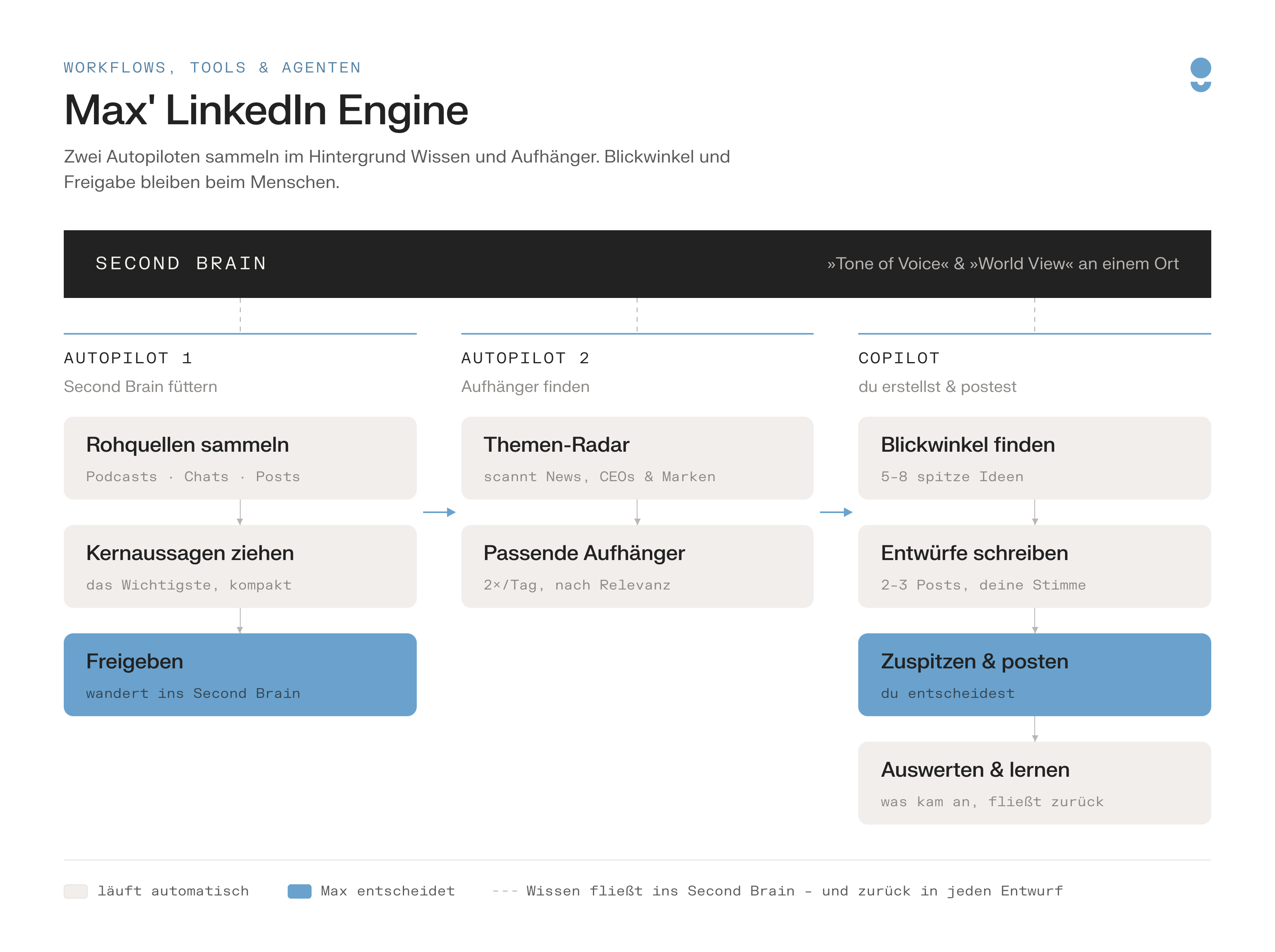
The same pattern answers the submitted question about how to automate posts for news already on your own website: an automated component detects new announcements and creates a first draft, then a human sharpens the angle and hits publish. The real effort lies in clearly defining which signals should trigger a draft in the first place. The actual automation is the easy part.
This question came from a consulting perspective, but it works just as well internally with management or specialized departments. The best approach: use the matrix from question 1 as a collaborative exercise. A process-mapping workshop where participants categorize their own recurring tasks along the two axes is more effective than any abstract tool presentation, because the ideas come from the people themselves rather than being imposed from the outside. By the way, we call this exercise the "Routine Radar": right now, all getpressis are sorting through their recurring tasks to uncover automation potential.
Not everyone is lucky enough to work in an AI-first company that provides training, offers tools, and explicitly encourages experimentation. In some corporations, only Copilot is approved; in others, nothing is allowed yet. Or there are only specialized AIs for specific areas that function more like databases than tools for your entire workday. The good news: the principles in this whitepaper—especially the matrix and the separation between automated steps and human approval—are intentionally tool-agnostic. They can be replicated with any approved tool.
The second tip costs nothing but curiosity: engage with AI outside of work hours, too. Max calls himself a tinkerer, and that is exactly why he is so good at working with AI—because he is genuinely interested in the subject, rather than just testing it out within the confines of work processes. On the weekend, he might install a new operating system on his e-scooter, build a restaurant recommendation app with friends, or create an AI sports coach that accesses his wearable data from Strava and similar platforms. Those who play like this have a decisive advantage on the job.
Several of you asked for solutions for small budgets. The good news: the biggest lever isn't a more expensive plan, but discipline in how you manage context. In the webinar example, seven habits reduced token consumption by about 80 percent:
None of this costs extra. All of it adds up.
The reason for this question: anyone using AI for media or competitive analysis wants to be able to include articles behind paywalls. The clean way to do this is GBI-Genios, a licensed marketplace where you can officially purchase press articles. For an automated integration, you will need the provider's API or a license agreement. Often, however, the straightforward approach is enough: simply take out a subscription and feed in the relevant articles when you want an analysis of them. We advise against automated paywall circumvention without a license, as this generally violates publishers' terms of service.
Now for the part that nobody loves but everyone needs. A quick disclaimer: We are not a law firm, and the following points do not constitute legal advice.
From that date, the transparency obligations under Article 50 of the EU AI Actwill apply. AI-generated images, videos, and audio must then be labeled, and chatbots must identify themselves as such; violations can result in significant fines. There is an exception for text that is crucial for PR work: if AI-generated text has been reviewed for content by a human and a named person or organization assumes editorial responsibility, the labeling requirement does not apply. For your PR texts, this means: as long as a human reviews and takes responsibility, you do not need to label them. If published without a content review, the obligation applies. Borderline cases should be referred to your legal department or law firm; Haufe provides a practical assessment.
It sounds like legalese, but it can be handled in three steps. The basic principle: personal or confidential data does not belong in a consumer tool without a clear data processing agreement. If you want to have your accounting sorted by Claude with visible customer data—as in one of the submitted questions—you need: a business or enterprise plan with the appropriate agreement, a look at Anthropic's current data privacy documentation, and, in case of doubt, pseudonymized fields. You should check these conditions before uploading sensitive data, not after.
If your question isn't covered here: the webinar recording contains several more answers, and you can find regular updates at get-press.de/webinars . And if you don't feel like overhauling your department yourself and would rather outsource your PR: We get it. Hit us up.
Community Q&A for the webinar "How AI-ready is your comms department really?" with Laura Lewandowski (smart chiefs) and Max Ziche (getpress).
©
0
getpress GmbH



%20(45).png)
).png)
%20(45).webp)
%20(1).webp)